
Vision 101: Farsighteness
Farsightedness is incredibly common—especially in children and adults over 40 but many people who are farsighted may not know it because their eyes may compensate… at least for a while.
So what is farsightedness, and why can it cause eye strain even if distance vision seems “fine”?
Farsightedness — Hyperopia by Another Name
The medical term for farsightedness is hyperopia, a word derived from ancient Greek meaning “over-vision.”
In a hyperopic eye, the eye is too short or not powerful enough, causing light to focus behind the retina instead of directly on it. As a result:
Near vision is blurry
Distance vision may be clear or blurry, depending on age and degree
The eyes must work harder to bring images into focus
Young eyes can often compensate using focusing muscles, which is why hyperopia is frequently missed in children and younger adults.
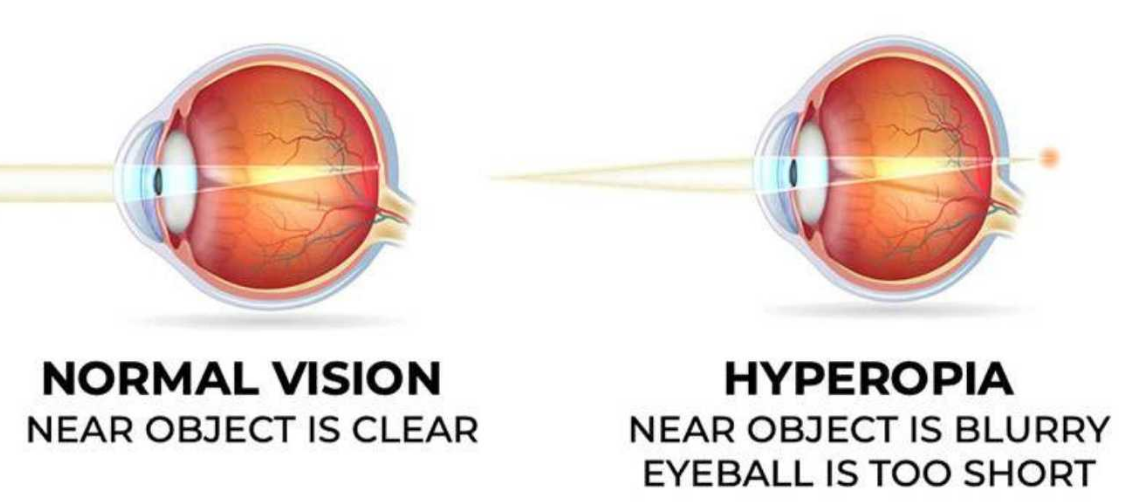
A normal eye vs an eye with hyperopia
A Normal Eye vs an Eye With Hyperopia
In a normal eye, light focuses precisely on the retina.
In a hyperopic eye, light focuses behind the retina, forcing the eye to constantly “pull” focus forward.
This extra effort can lead to:
Eye strain
Headaches
Fatigue with reading or screen use
Avoidance of near work (especially in kids)
How to Measure Hyperopia?
Hyperopia can be corrected in several ways:
Glasses are the most common treatment. They use plus-power lenses to move the focal point forward onto the retina, reducing strain and improving clarity—especially at near.
Contact lenses are an excellent option for many hyperopic patients. Your eye doctor can help determine the best lens type based on your prescription, eye health, and lifestyle
Procedures such as LASIK or PRK can permanently correct certain amounts of hyperopia by reshaping the cornea.
In higher prescriptions, an implantable lens placed inside the eye may be an option.
How Is Hyperopia Measured?
Eye doctors measure hyperopia in diopters (D), typically in steps of 0.25 D. Because farsightedness is corrected with plus lenses, prescriptions are written with a plus (+) sign.
Low: +0.25 D to +2.00 D
Moderate: +2.25 D to +5.00 D
High: +5.00 D and above
Is Hyperopia a Problem?
Hyperopia isn’t just about blurry vision.
Uncorrected farsightedness can contribute to:
Chronic eye strain and headaches
Difficulty with reading and learning in children
Poor concentration
Earlier onset of reading glasses
Eye alignment issues (such as crossed eyes) in kids
Because the eye may “hide” hyperopia by over-focusing, a comprehensive eye exam is the only reliable way to detect it.
How Do I Know If I Have Hyperopia?
The simplest answer: get an eye exam.
If you already have a glasses prescription, look under Sphere (SPH); plus (+) number means you have hyperopia
Even small amounts can matter—especially if you experience eye fatigue, headaches, or difficulty with near work.
Farsightedness (Hyperopia) — FAQ
Is farsightedness normal in children?
Yes. Many children are naturally farsighted, and young eyes can often compensate. However, significant hyperopia can affect learning and eye alignment.
Why do I have eye strain if I see far away clearly?
Even if distance vision is clear, the eyes may be working overtime to focus, leading to fatigue, headaches, and discomfort.
Does hyperopia get worse with age?
Hyperopia itself may not worsen, but the eye’s ability to compensate decreases with age—often revealing symptoms in adulthood.
Is hyperopia the same as needing reading glasses?
Not exactly. Hyperopia is a refractive error present from early life, while reading glasses are usually needed due to age-related focusing changes (presbyopia).
Should mild hyperopia be corrected?
Sometimes yes—especially if symptoms like eye strain or headaches are present. Your eye doctor will determine what’s appropriate.
