
Vision 101: Astigmatism
Astigmatism is one of the most common vision conditions, yet it’s also one of the most misunderstood. Many people are surprised to learn they have it—often because they’ve been told they’re “nearsighted” or “farsighted,” without realizing astigmatism can exist alongside both.
So what exactly is astigmatism, and why can it make vision feel blurry, distorted, or tiring?
Astigmatism — What Does That Mean?
"Astigmatism" originates from the Greek roots a meaning "without" or "absence of" and stigma "a point" or "mark".
Astigmatism occurs when the front surface of the eye (the cornea) or sometimes the lens inside the eye is not perfectly round.
Instead of being shaped like a basketball, an astigmatic eye is shaped more like a football.
Because of this uneven curvature:
Light does not focus at a single point on the retina
Images appear blurred, shadowed, or distorted at all distances
Vision may fluctuate or worsen with fatigue
Astigmatism is not an eye disease—it’s a natural variation in eye shape. In fact, most people have a little bit of astigmatism because most eyes are not perfectly round.
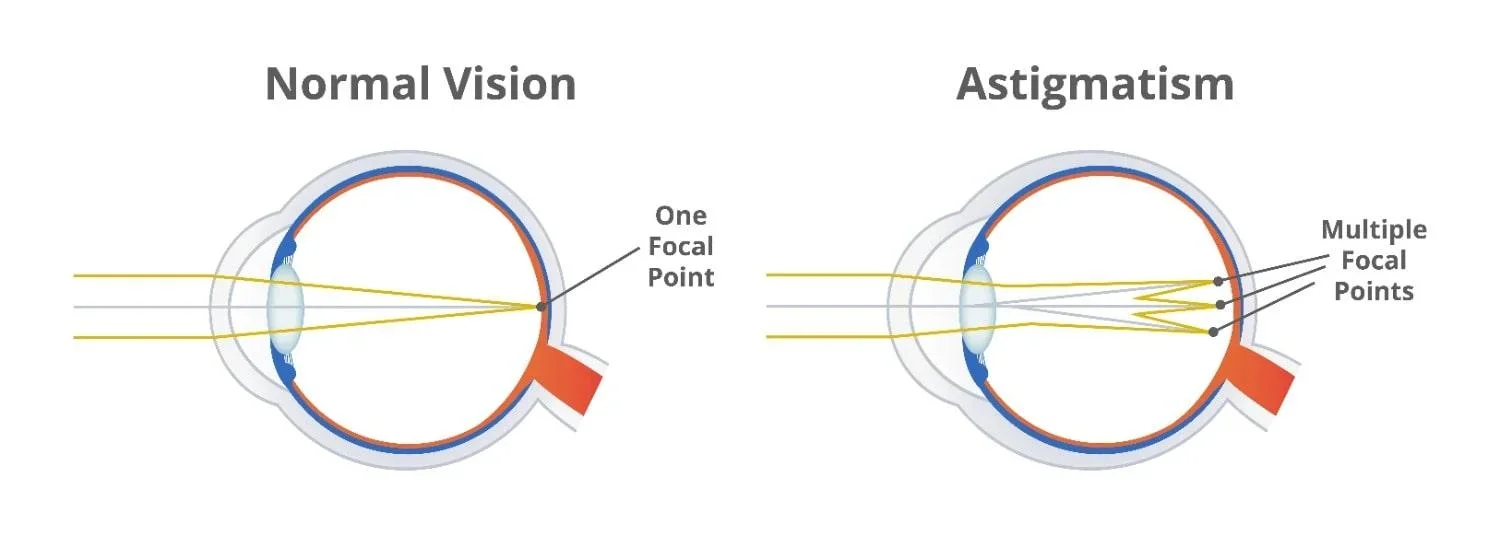
A normal eye vs an eye with astigmatism
A Normal Eye vs an Eye With Astigmatism
In a normal eye, light rays focus to one clear point on the retina.
In an eye with astigmatism, light focuses at multiple points, either in front of or behind the retina, leading to distorted vision.
Common symptoms include:
Blurry or smeared vision
Difficulty with night driving
Eye strain or headaches
Squinting
Fatigue with screens or reading
How is Astigmatism Corrected?
Astigmatism can be corrected very effectively with:
Glasses correct astigmatism using cylindrical (CYL) power, which compensates for the uneven curvature of the eye and brings light into a single focus.
Several specialized contact lenses exist to correct astigmatism including soft-toric lenses, rigid gas permeable lenses, and scleral lenses. Your eye doctor will recommend the best lens for your needs.
Procedures such as LASIK or PRK can correct certain amounts of astigmatism by reshaping the cornea. In higher prescriptions, other surgical options may be considered.
How Is Astigmatism Measured?
Astigmatism is measured in diopters (D), using two components:
Cylinder (CYL): the amount of astigmatism
Axis: the orientation (direction) of the astigmatism, measured in degrees from 1–180
Like other refractive errors, measurements are typically in 0.25 D increments.
Typical ranges:
Low: up to 1.00 D
Moderate: 1.25 D to 3.00 D
High: greater than 3.00 D
Astigmatism can occur with myopia, with hyperopia, or on its own.
Is Astigmatism a Problem?
Astigmatism itself isn’t dangerous—but uncorrected astigmatism can significantly affect quality of life.
Left uncorrected, it may contribute to:
Chronic eye strain and headaches
Poor night vision
Reduced visual clarity even with “good” distance vision
Learning difficulties in children
Visual fatigue with prolonged screen use
Because astigmatism often develops early in life, children may not realize their vision isn’t normal.
How Do I Know If I Have Astigmatism?
Easy answer— get an eye exam.
If you already have a glasses prescription, look for: A number listed under CYL (cylinder) and a corresponding AXIS value. If those fields are filled in, you have astigmatism.
While small amounts of astigmatism— remember most people have a bit— may not need correction, the only way to know is to check!
Astigmatism — FAQ
Is astigmatism an eye disease?
No. Astigmatism is a common variation in eye shape and is not a disease.
Can astigmatism cause headaches?
Yes. Uncorrected astigmatism can lead to eye strain, headaches, and fatigue, especially with prolonged screen use.
Does astigmatism affect distance or near vision?
Both. Astigmatism can cause blurry or distorted vision at all distances.
Can astigmatism change over time?
Yes. Astigmatism can change slowly over time, which is why regular eye exams are important.
Why do my glasses prescription numbers look complicated?
Astigmatism requires both a strength (CYL) and a direction (AXIS), which is why prescriptions include more numbers.
