
Vision 101: Nearsightedness
Over 40% of Americans and about 2.6 billion people worldwide are nearsighted.
You may have heard someone saying that they are “nearsighted” or maybe you’ve even been told that YOU are nearsighted and need to wear corrective lenses. But what IS nearsightedness and why do lenses even help?
Nearsightedness— Myopia by Another Name
The technical term for nearsightedness is myopia which, like many medical terms is derived from ancient Greek. Eyes that are myopic —have myopia—are either too long or too strong and light ends up focusing ahead of the retina.
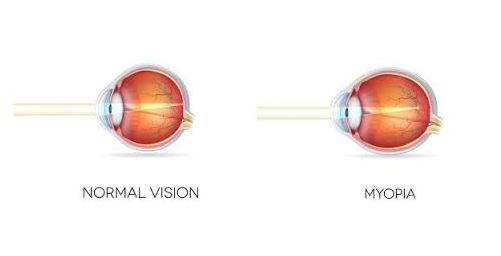
A normal eye vs an eye with myopia
How Is Myopia Corrected?
Myopia can be corrected with glasses, contact lenses, or surgery.
Glasses are the most common way to correct myopia. The glasses use minus-power lenses to help re-focus the image on the retina.
Contact lenses are another great option for myopic correction. There are several types of contact lenses— your eye doctor can help you decide which lens is right for you.
Refractive surgery such as LASIK or PRK can provide a permanent correction for myopia by re-shaping the cornea, the clear front part of the eye. Another option is to place an Implantable Collamer lens— a lens that is surgically placed inside the eye
How to Measure Myopia?
Eye doctors measure the amount of myopia, and other refractive errors in diopters with the smallest standard unit of measurement being 0.25 D (diopters) some older units measure 0.12 D). Because myopia is corrected with minus lenses, we add a minus sign.
Low: -0.25D to -3.00D
Moderate: -3:00D to -6.00D
High: -6.00 D and above
Is Myopia Dangerous?
Individuals with -6.00 D or more of myopia are at an increased risk for developing certain ocular conditions including glaucoma and retinal tears; they also develop cataracts sooner compared to their peers.
How Do I Know If I Have Myopia?
Simple— get an eye exam. Or, if you’ve recently had an eye exam, look at your glasses prescription. If the numbere under sphere (or SPH) has a minus in front of it you have some degree of myopia.
Nearsightedness (Myopia) — FAQ
What causes myopia?
Myopia is caused by the eye being too long or too strong, causing light to focus in front of the retina. Genetics and prolonged near work both play a role.
Can myopia get worse over time?
Yes. Myopia often progresses during childhood and adolescence and may stabilize in adulthood. Some adults experience progression later in life.
Is myopia reversible?
Myopia cannot be reversed naturally, but it can be corrected with glasses, contact lenses, or refractive surgery.
Does screen time cause myopia?
Excessive near work and limited outdoor time are associated with higher rates of myopia, especially in children.
Why is high myopia a concern?
Higher levels of myopia increase the risk of retinal tears, glaucoma, and early cataracts, making regular eye exams essential.
