
School Vision Screening vs. Comprehensive Eye Exam
What’s the Difference?
Many parents assume that if their child passes a school vision screening, their eyes are healthy.
However, a screening and a comprehensive eye exam are very different.
Here’s a clear comparison:
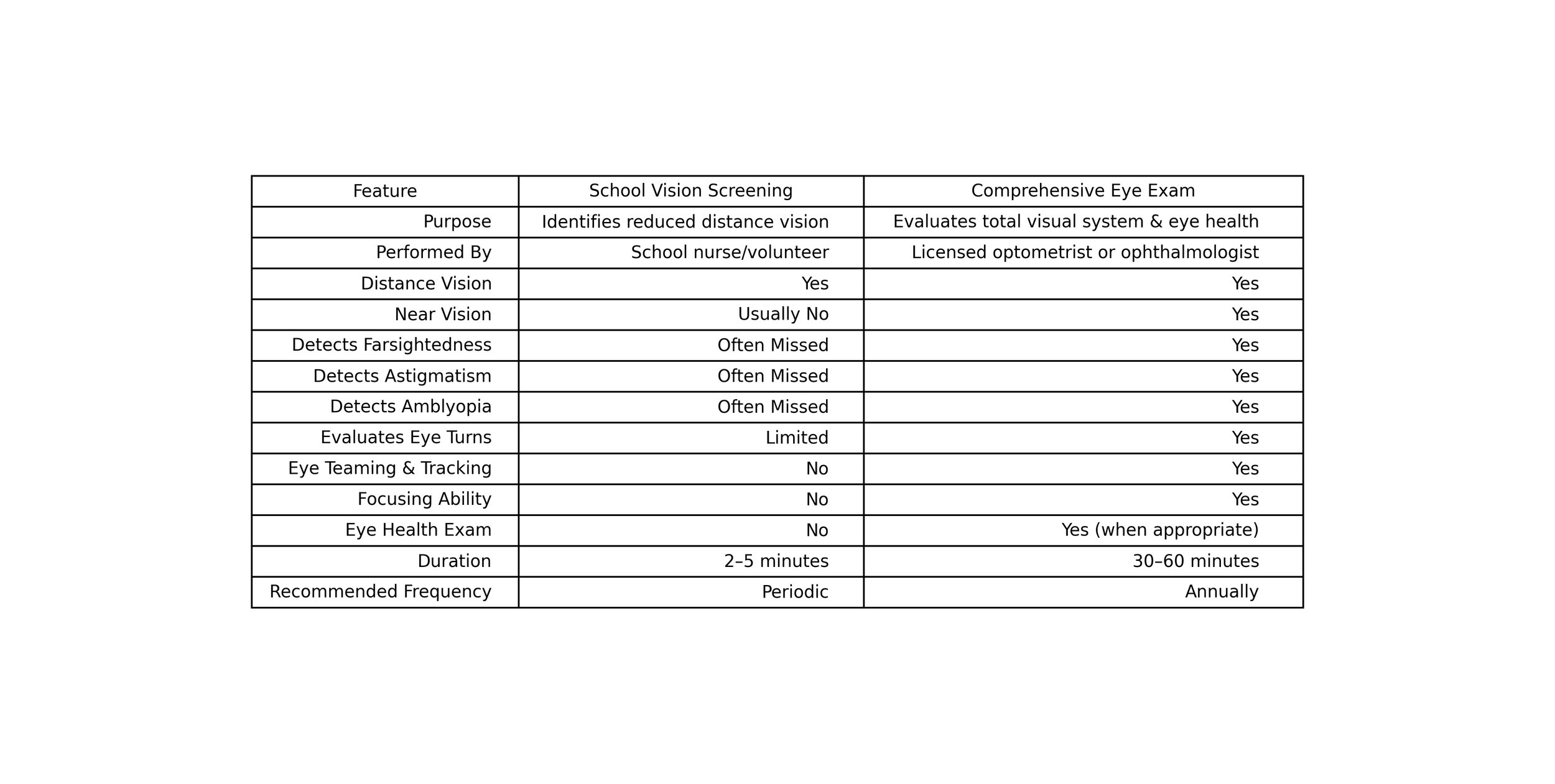
Why Screenings Miss Problems
School screenings are designed to quickly detect reduced distance visual acuity.
They do not evaluate:
Binocular vision disorders
Focusing problems
Eye health
Depth perception
Early amblyopia
Mild refractive errors
A child can pass a screening and still struggle with:
Reading fluency
Attention
Headaches
Eye strain
Classroom performance
What a Comprehensive Eye Exam Evaluates
A comprehensive pediatric eye exam assesses:
Visual acuity (distance & near)
Refractive error (myopia, hyperopia, astigmatism)
Eye alignment
Eye teaming and tracking
Focusing ability
Depth perception
Color vision (when appropriate)
Ocular health
Retinal and optic nerve health
The American Optometric Association recommends:
First eye exam at 6 months
Another between ages 3–5
Annual exams during school years
The Bottom Line
School vision screenings are helpful — but they are not comprehensive.
They are a first step, not a final answer.
A comprehensive eye exam provides a complete evaluation of how a child sees, how their eyes work together, and whether their eyes are healthy.
When it comes to children’s vision and development, a screening is not a substitute for a full exam.
