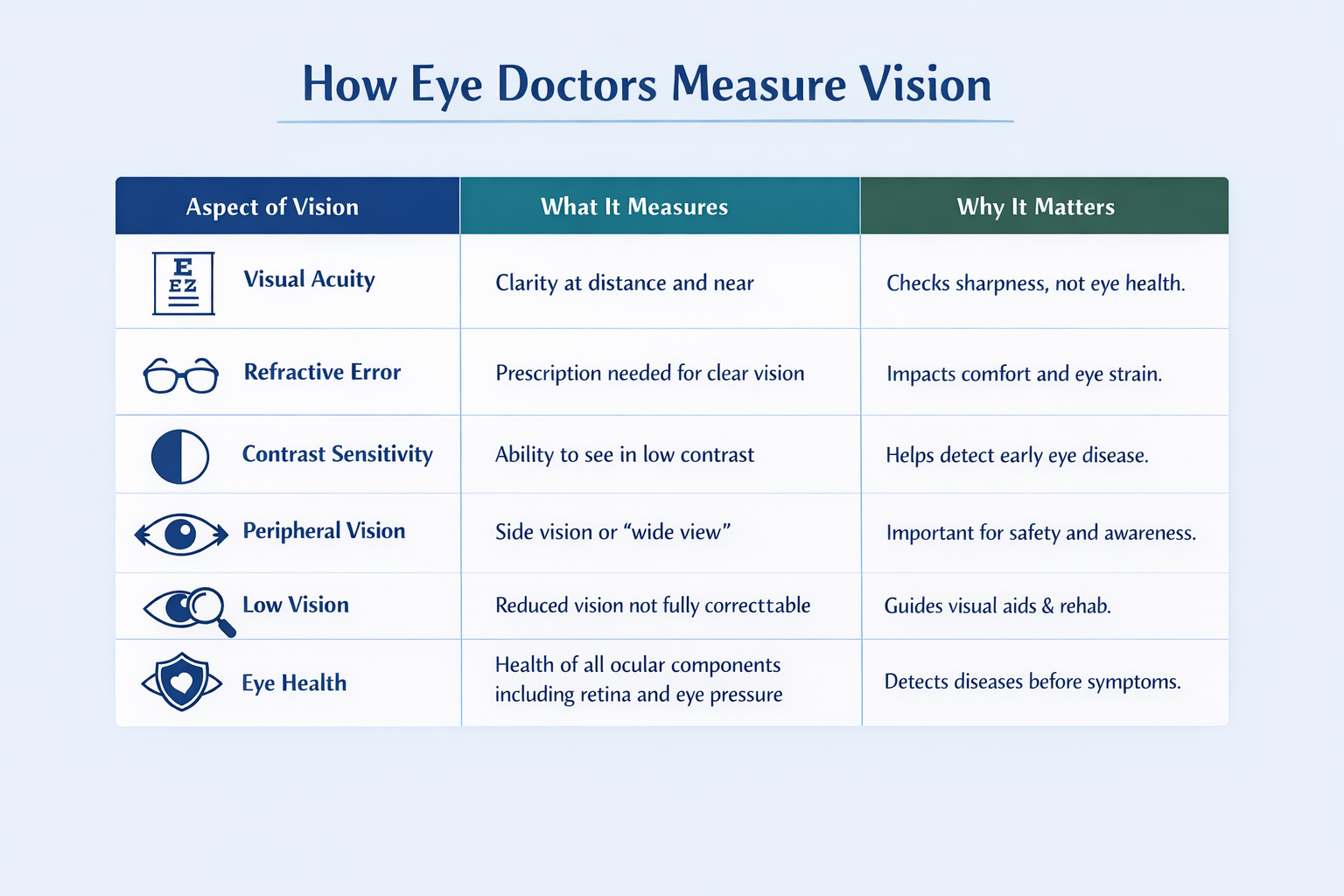
Vision 101: How Do We Measure Vision
Here's a polished version with improved grammar and a more natural, reader-friendly tone:
When most people think about vision, they think about 20/20 eyesight. But vision is much more than reading letters on a chart. Eye doctors measure vision in several different ways to understand how well your eyes really work in daily life.
Here are the main ways we evaluate vision during an eye exam:
1. Visual Acuity
Visual acuity measures how clearly you see at distance and up close. Distance vision is usually tested at 20 feet, while near vision is tested at reading distance—about 40 centimeters.
When we say someone has 20/20 vision, it means that what most people can see clearly at 20 feet, you can also see clearly at 20 feet. On the other hand, if your vision is 20/40, you have to stand 20 feet away to see what others can see from 40 feet away. Some people even have better than 20/20 vision—like 20/10 or 20/15.
Your eye doctor will look at both corrected and uncorrected visual acuity. Uncorrected visual acuity is measured without glasses or contact lenses. Corrected visual acuity is how well you can see with glasses or contact lenses—many people who need correction will see 20/20 or better with their lenses.
Having 20/20 vision doesn't mean your eyes are perfect—just that your clarity meets a standard benchmark. Many people are surprised to learn that you can have 20/20 vision and still have eye problems.
2. Refractive Error (Prescription Strength)
Refractive error describes how much correction your eyes need to see clearly. This includes nearsightedness (myopia), farsightedness (hyperopia), astigmatism, and presbyopia (age-related near vision changes).
Two people can both see 20/20 with glasses but have very different prescriptions, which affects eye strain, comfort, and long-term eye health.
3. Contrast Sensitivity
Contrast sensitivity measures how well you can see objects that don't stand out clearly from their background. This is especially important for night driving, navigating foggy or low-light conditions, reading faint print, and early detection of eye disease.
Reduced contrast sensitivity is often one of the earliest changes in conditions like cataracts, glaucoma, and retinal disease—even before vision feels "blurry."
4. Peripheral (Side) Vision
Peripheral vision refers to what you can see off to the sides without moving your eyes. This is critical for driving, walking safely, detecting motion, and overall spatial awareness.
Loss of side vision can happen gradually and often goes unnoticed, which is why testing peripheral vision is essential for detecting diseases like glaucoma.
5. Low Vision
Low vision means reduced vision that cannot be fully corrected with glasses, contact lenses, or surgery. This does not mean blindness. People with low vision often benefit from specialized visual aids, lighting changes, magnification tools, and vision rehabilitation strategies.
Understanding low vision helps patients maintain independence and quality of life.
The Bottom Line
Vision is not a single number on a chart—it's a combination of clarity, comfort, contrast, field of view, and how your eyes function together.
The best way to ensure your eyes are healthy is to have an eye exam every year, or as directed by your eye doctor.